Diverse and manageable Art fair! What can be better..as far as art fairs go.
The Contemporary African Art fair 1:54, the brainchild of Tourai El Glaoui, took place in London a couple weeks ago for its third London edition at the Somerset House. The word was clearly out that it was the place to be; the fair was gaining serious traction: more visitors, more exhibitors (38 of them), more artists. I heard some enthusiastic feedback from newcomers. Many liked the diversity of expression, the manageable size of the fair and the galleries’ enthusiastic endorsement of their artists.

I felt that the works displayed at Anne de Villepoix, a French gallery that has been showing African artists for many years, were strong. She offered a mix of recently produced works but also earlier works (early 2000) conveying a sense of history and scope to contemporary African art. A striking 2001 photographic diptych “Static Drift” by Ingrid Mwangi was hanging over the fireplace. Born in Kenya, daughter of a Kenyan father and German mother she was transported to Germany in her teens where she has settled and is now married to a German artist, Robert Hutter, with whom she works closely. In this work she uses her body as canvas. She addresses personal issues, such as her constant discomfort because of her mixed race status of always feeling the odd one out whether she is in Kenya or Germany – never black or white enough – and of broader issues of nationalism, colonialism and post colonialism. She challenges preconceptions of the African continent by showing it as a white shape and refers to the past colonial might of Germany by making it proportionally much larger. However the words she uses point to a different reality: of an African continent on the rise and of a Germany in decline. In the context of today’s current events this work made in 2001 seems prescient at least in terms of Germany’s aging population and slowing economy in contrast to Africa’s higher growth rate and growing population. However as with everything in life reality is more of a mixed bag. Economic growth in Africa while stronger than in Europe is not keeping pace with its population growth on the continent and many of the young are seeking jobs up in the Global North.
Mwangi’s use of her naked body to speak of boundaries evokes other thoughts in my mind. I think of the history of desire for the “exotic” or for the one that is different from oneself, and of how the female body has and is still in some cultures seen as the territory of men.
Here Mwangi reclaims her body. As she says: “ My body is the only thing that I own…I react, interpret and question the clichés and stereotypes with which I am faced..I use art to awaken consciences.”
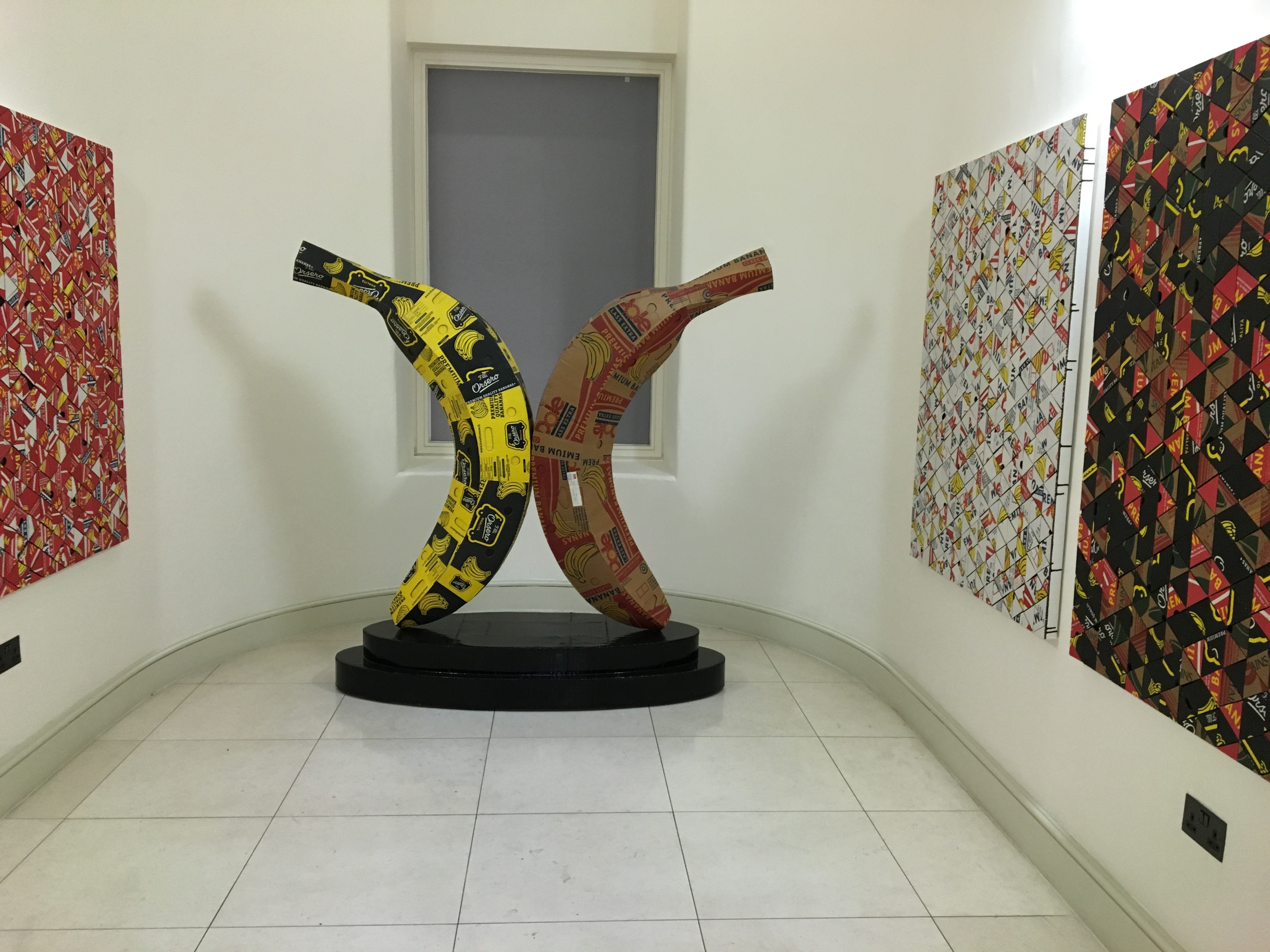
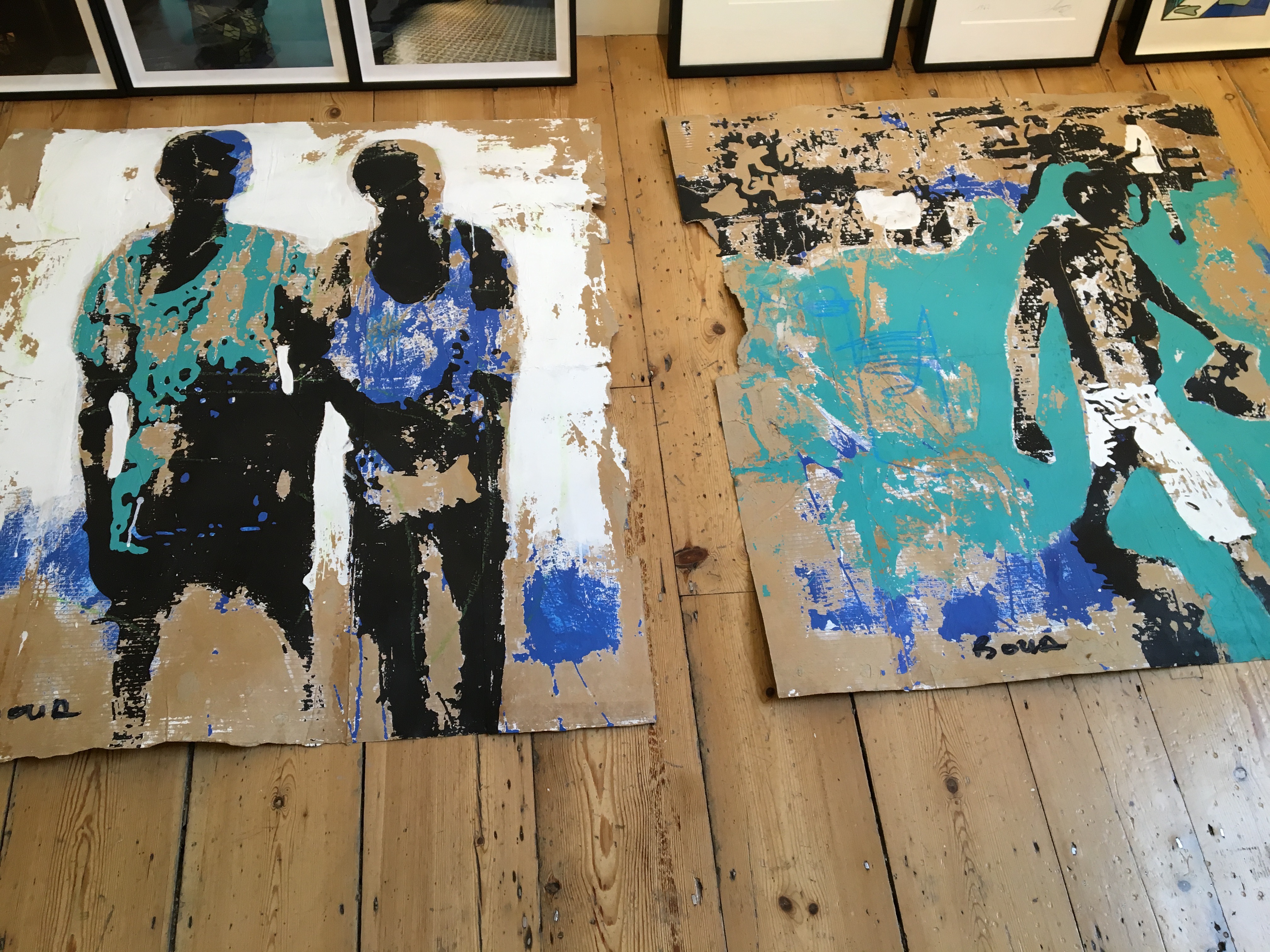
Some other strong pieces graced Anne de Villepoix’s walls:
 Barthélemy Toguo,
 Omar Ba,
 and Yashua Klos.

It was a first in London for Axis Gallery that had participated in 1:54 in New York and I was intrigued by the installation by Hervé Youmbi Two-Faced/Double Visage from his project Faces of Masks and while not quite successful visually I found it thought provoking. In this project Youmbi purposefully blurs boundaries between the ethnological and the contemporary, and between distinct tribal styles challenging systems of classification that have been historically favored by Western museums. He commissioned the Bamileke craftspeople from Cameroon to create a hybrid Ku’ngang mask incorporating the face of a Dogon mask from Mali. Once the chief of the Ku’ugang Society authorized the mask it was then activated during a ritual masquerade, which Youmbi filmed. One of the masks included in the installation incorporated Edvard Munch’s Scream: another example of hybridity. In reality ritual masks from some tribal African groups have morphed along the centuries and have absorbed elements from other cultures. For instance early 20th century Yoruba Gelede masquerade masks incorporate colonial figures, and later elements of modernity such as bicycles. Museums have had a tendency historically to favor less hybrid pieces but things are changing. Also I just reviewed an exhibition of George Osodi’s photographs of Nigerian Monarchs where the contemporary and the ethnological were held in tension through out. It is good of Youmbi to challenge any simplistic or essentialist approach.

Axis was also showing the work of Jebila Okongwu.


I was pleasantly surprised to see a whole room dedicated to the poetic photographic work of Mohamed Camara. This is a lovely body of work that he did a few years back and sadly he has not produced new work since then as far as I know.

I liked the work of Zak Ové at Vigo gallery. Assemblage and collage are used for expressive means.

Here he finds objects that he picks up from the Thames and assembles them.


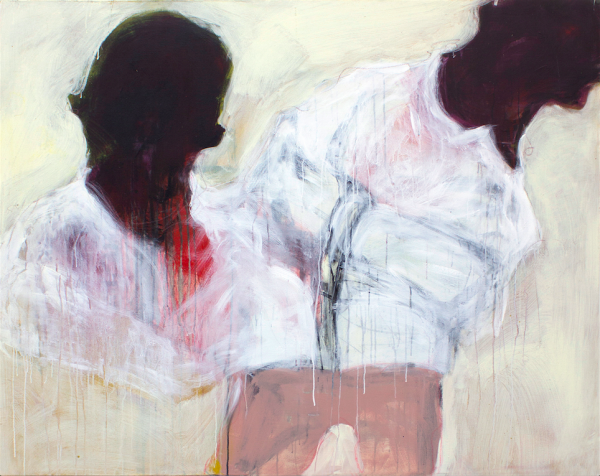
Aboulia and Armand Boua at Jack Bell gallery,

Beatrice Wanjiku at Artlab gallery

Délio Jasse at Tiwani Contemporary
 Nemsa Leuba at Art Twenty One
 Mimi Chereno Ng’ok at the Fondation Donwahi; she is showing at Les Rencontres de Bamako currently.
 Billie Zangewa

Clay Apenouvon at Mariane Ibrahim, a gallery from Seattle whose presence on the international art scene is on the rise.
A few words of caution I feel need to be said. It is great that Contemporary African Art is getting much more attention in the West and that an international market for these artists’ work is taking shape. The only problem is that the pricing shifts to reflect an international pricing and gradually the works will be too expensive for a local middle-class African audience who already is slow to wake up to the idea of buying and supporting its contemporary artists.
Recent Comments